Hard Money Loan Calculator: Payments, Points & ARV
A hard money loan can fund a flip in days, but its real price hides in four numbers: the interest rate, the points, the lender's loan-to-value limits and how long you hold the property. This hard money loan calculator puts all four together, showing your monthly interest, upfront points, the balloon payment at payoff and the total cost of borrowing before you sign a term sheet.
Below the calculator you'll find the formulas it uses, the loan terms lenders commonly quote in 2026, a fully worked example, and a simple test that shows whether a lower rate with more points actually saves you money.
Hard money loan calculator
Estimates only. Title, insurance, appraisal and closing costs are not included. "Cash needed at closing" excludes the monthly interest you pay during the hold.
What is a hard money loan?
A hard money loan is a short-term, asset-based loan from a private lender or a non-bank lending company. The lender cares mostly about the property and your exit plan (selling or refinancing) rather than your personal income, so approval takes days instead of weeks. The trade-off is price: hard money costs noticeably more than a bank mortgage, and the loan usually runs only 6 to 24 months.
How it differs from a bank mortgage
A conventional mortgage amortizes over 15 to 30 years, so every payment repays some principal. A hard money loan is almost always interest-only: you pay interest each month and repay the whole principal at the end in one lump sum. The Consumer Financial Protection Bureau calls this a balloon payment: a large, one-time payment at the end of the loan.
Who uses hard money
Fix-and-flip investors use it to buy and renovate quickly. Buy-and-hold investors use it as the first step of the BRRRR method (buy, rehab, rent, refinance, repeat) before refinancing into a long-term rental loan. Investors whose income is hard to document also use it, because underwriting leans on the deal rather than tax returns.
How the hard money loan calculator works
The calculator follows the same arithmetic a lender uses on a term sheet. Here is each piece, so you can check any quote by hand.
1. The loan amount (LTV, LTC and ARV limits)
Lenders cap the loan in two ways and fund the smaller of the two:
- Cost limit (loan-to-cost): a share of the purchase price plus a share of the rehab budget, for example 90% of the purchase and 100% of the rehab.
- Value limit (loan-to-ARV): a share of the after-repair value, commonly 70–75% of ARV.
Whatever the loan doesn't cover, you bring as a down payment. That's why two investors with the same purchase price can receive very different loans: the one with the stronger ARV gets more money.
2. The monthly payment
Because the loan is interest-only, the payment is simply loan amount × annual rate ÷ 12. Some lenders charge interest on the full loan from day one, including rehab money they haven't released yet (often called "Dutch" interest). Others charge interest only on funds you've drawn. Switch the calculator's setting to compare the two: the "drawn" option assumes your rehab funds are drawn evenly, so on average half the rehab money is outstanding.
3. Points and fees
One point equals 1% of the loan amount, paid at closing. On a $230,000 loan, 2 points cost $4,600. Lenders often add underwriting, processing and draw-inspection fees on top, so ask for every fee in writing.
4. Total cost of borrowing and the balloon
The total cost is monthly interest × months held + points + fees. When you sell or refinance, you repay the original principal in full: that's the balloon payment. The calculator also annualizes your total cost, which makes a 6-month loan comparable with a 12-month one.
Typical hard money loan terms in 2026
Pricing depends on your experience, the property, the leverage you ask for and the length of the loan, so treat these as the ranges commonly quoted in 2026 lender guides (for example RentalRealEstate and Financer), not as a quote.
| Term | Common range | What moves it |
|---|---|---|
| Interest rate | about 8%–15% a year (9%–12% most often) | Track record, leverage, property type |
| Points | about 1–3 points, sometimes up to 5 | Experience, rate you choose, deal size |
| Loan-to-value (as-is) | about 65%–80% | Property condition, location |
| Loan-to-ARV | about 70%–75% | Strength of the comps behind the ARV |
| Loan term | 6–24 months, interest-only | Size of the rehab, exit plan |
| Other fees | underwriting and processing fees; per-draw inspection fees | Lender, number of rehab draws |
| Prepayment penalty | none at many lenders; some charge a few months' interest | Lender policy: always ask |
Worked example: a $250,000 flip
Here are the calculator's default numbers, step by step.
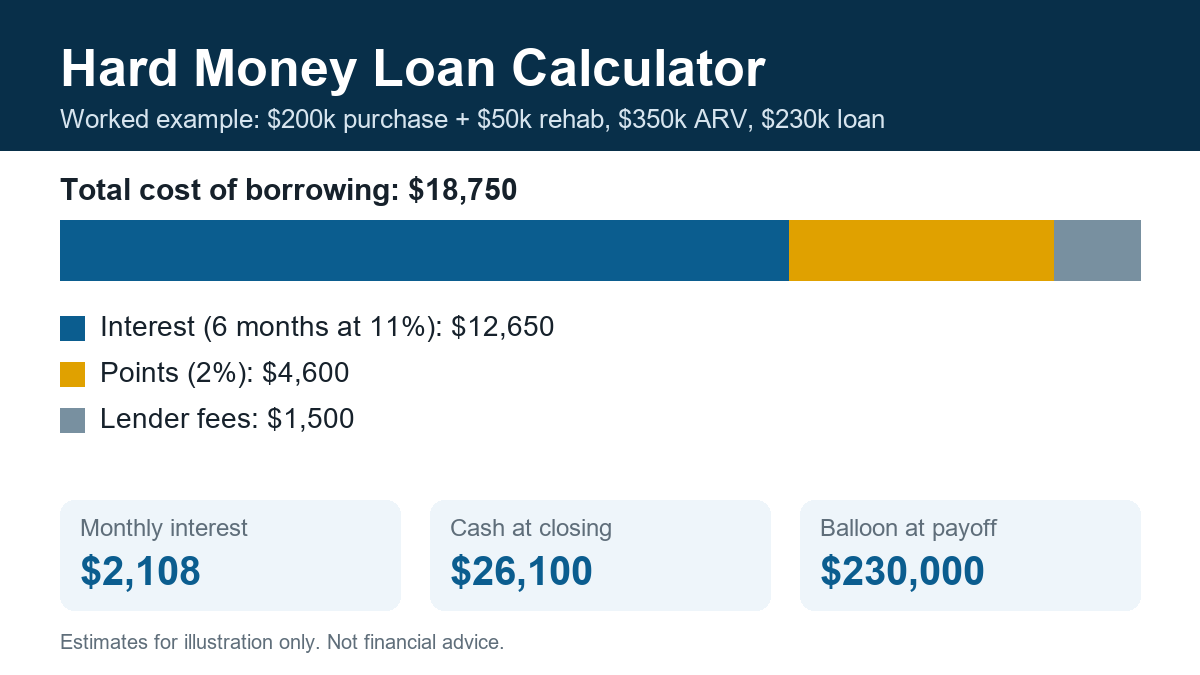
- Deal: $200,000 purchase, $50,000 rehab, $350,000 ARV.
- Lender limits: 90% of purchase + 100% of rehab = $230,000. The ARV limit is 70% × $350,000 = $245,000. The smaller figure wins, so the loan is $230,000 (92% loan-to-cost, 65.7% loan-to-ARV).
- Monthly interest at 11%: $230,000 × 0.11 ÷ 12 = $2,108.
- Six-month hold: $2,108.33 × 6 = $12,650 in interest.
- Points: 2% × $230,000 = $4,600. Fees: $1,500.
- Total cost of borrowing: $12,650 + $4,600 + $1,500 = $18,750, about 16.3% a year once annualized.
- Cash at closing: ($250,000 − $230,000) + $4,600 + $1,500 = $26,100.
- Balloon at payoff: the full $230,000.
The flip check then subtracts 8% selling costs ($28,000) and $800 a month of holding costs ($4,800). Estimated profit: $322,000 − $200,000 − $50,000 − $18,750 − $4,800 = $48,450. One warning sign: the 70% rule says the maximum offer is 70% × $350,000 − $50,000 = $195,000, so this purchase is $5,000 above that guideline.
If the same lender charged interest only on drawn rehab funds, the average balance would be $205,000, cutting interest from $12,650 to about $11,275: a $1,375 saving from a single line in the term sheet.
Lower rate or fewer points? The break-even test
Lenders often offer a choice like "9.5% with 3 points" or "11% with 1 point." The cheaper option depends on how long you'll hold the loan. On a $230,000 loan:
| Offer | Points at closing | Monthly interest |
|---|---|---|
| 9.5% + 3 points | $6,900 | $1,820.83 |
| 11% + 1 point | $2,300 | $2,108.33 |
The low-rate offer costs $4,600 more upfront and saves $287.50 a month, so it breaks even after $4,600 ÷ $287.50 = 16 months. For a typical 6–9 month flip, the 11% loan with 1 point is cheaper. Only a long, slow project favors buying the rate down. Run both offers through the calculator with your real hold time before choosing.
Hard money vs. private money, DSCR and bridge loans
| Loan | Best for | Typical length | Approved mainly on |
|---|---|---|---|
| Hard money loan | Fix-and-flip, heavy rehab | 6–24 months | The property and the ARV |
| Private money loan | Investors with a personal lender network | Negotiated | Your relationship and the deal |
| Bridge loan | Buying before selling, stabilizing a property | 6–36 months | As-is value and the exit |
| DSCR loan | Long-term rentals; refinancing out of hard money | 30 years | The rent covering the payment |
How to lower the cost of a hard money loan
- Shorten the hold. Interest is charged monthly, so a tighter rehab schedule saves real money. Order materials and line up contractors before closing.
- Negotiate points with experience. Lenders price repeat borrowers better, so bring a list of completed projects.
- Ask about interest on drawn funds only. As the example shows, it can save over $1,000 on a modest rehab.
- Get every fee in writing. Underwriting, processing, draw inspection, extension and prepayment terms all change the true cost.
- Plan the exit before you borrow. If you'll refinance into a rental loan, check that the rent will qualify. An extension because the exit stalled is the most expensive mistake.
A note on taxes
For rental property, IRS Publication 527 says you generally can't deduct the full amount of points in the year you pay them, but must deduct them over the term of the loan (IRS Publication 527, "Points"). Flips held for resale can be treated differently, so ask a tax professional how your points and interest should be handled.
Frequently Asked Questions
How is a hard money loan payment calculated?
Most hard money loans are interest-only, so the monthly payment is the loan amount times the annual interest rate, divided by 12. A $230,000 loan at 11% costs about $2,108 a month. The principal is repaid in one balloon payment when you sell or refinance.
What is a typical hard money loan interest rate in 2026?
Lender guides commonly quote about 8% to 15% a year, with 9% to 12% most frequent. Experienced investors with strong deals get the lower end; first-time borrowers, high leverage and ground-up construction sit higher.
What does 2 points mean on a hard money loan?
One point is 1% of the loan amount, paid at closing. Two points on a $230,000 loan cost $4,600. Points are separate from the interest rate, so compare offers using the total cost over your expected hold, not the rate alone.
How much can I borrow with a hard money loan?
Lenders fund the smaller of a cost limit (for example 90% of the purchase plus 100% of the rehab) and a value limit (commonly 70% to 75% of the after-repair value). You cover the difference as a down payment.
Do hard money loans have prepayment penalties?
Many short-term hard money loans have no prepayment penalty, but some lenders charge a few months of interest if you repay early. Ask for the prepayment, extension and default terms in writing before you sign.
Final verdict
A hard money loan is a tool for speed, and it only pays off when the deal still works after the full cost of the money. Before you accept a term sheet, run three checks in the calculator: does the loan amount match your cash plan, does the flip still profit with a hold two months longer than you expect, and which points-versus-rate option is cheaper for your timeline? If all three pass, you're borrowing with your eyes open.